

The “online presence” of your website
Do you still treat your website as an online brochure?
Almost every business has a company profile and an online presence, but being “online” just to exist is no longer enough. Today, saying“I have a website”should mean thatyou are up to date.As a business owner, you should be ahead of the “online presence”. The website is just the beginning.
Having a website is the least you should do, because a website is a digital shop window: it is the customer's first contact with your services. A website is a powerful tool that every business should have. Alongside marketing, this shop window must be put to work so that your customer base can grow and be retained.
An outdated mindset: the website is a digital brochure.
For many companies, especially those in more traditional sectors, websites are mostly informational tools. They provide basic company details, such as contact information, and sometimes mention products and services. That is it: a digital brochure.
However, this approach does not meet today's expectations, neither those of users nor those of your company.
An effective website today should:
• Be visible in search engines
• Be optimised for engagement
• Be properly designed
• Incorporate a sales and marketing strategy
Your website is a business tool, not just a presence
A strong website works harder than any salesperson. It doesn't sleep, it doesn't take breaks and it can serve every customer at any moment. Above all, a strategic website isn’t the same as a passive one.
1. It attracts the right people
SEO (search engine optimisation) ensures that your website appears to people searching for the services and products you offer. This means your website can organically attract users with greater interest, without the need for paid advertising.
2. It builds trust and authority
Before a user becomes a customer, they first need to trust you. Your website can play a decisive role in this by showcasing relevant case studies, testimonials, clients, certifications and clear value propositions.
3. It turns visitors into customers
A website designed according to the principles of Conversion Rate Optimisation (CRO) does not simply provide information. What it does is guide users to take action. Whether it is buying a product, booking a consultation or submitting a form, the website should always be aligned with your business goals.
4. It is business intelligent
Modern websites are not static pages; they are data hubs. By using analytics tools you can learn how visitors behave on your website, what interests them and what doesn't. This way, optimisation is based on real data.

5. The real cost of treating your website as a shop window
A very common scenario: a company builds a website and does nothing with it for years. It simply provides some information but plays no part in the company's growth. In reality, these “shop windows” have a hidden cost.
• Lost prospects due to poor user experience
• Lack of optimisation means lost revenue
• Wasted advertising spend
• A poor brand image if the website is outdated or unprofessional
If your website is not helping your business grow, then it is holding it back.
Common website mistakes businesses make
To understand the value of your website, you first need to avoid the pitfalls that put its effectiveness at risk. These are the most common mistakes:
- Prioritising design over functionality
A visually impressive website can still underperform if it does not meet users' expectations or does not guide them to act. Good design should support usability, not the other way round. - Ignoring mobile optimisation
With 60% of internet traffic coming from mobile devices, a website that is not mobile-friendly is not just a poor experience; it is a serious competitive disadvantage. - Underestimating content
Weak, generic and outdated content not only fails to attract users but also harms the website's visibility in search engines. - Lack of CTAs: users don't take action (CTA)
Many websites do not prompt visitors to take the next step. Every important page should include a clear call to action (CTA) that connects users with their intent. - Neglecting SEO
Technical SEO, keyword targeting, data, internal linking: none of these are optional. If users cannot find your website through search engines, you are losing quality traffic. - No data-driven decisions
Relying on outdated data or assumptions leads to ineffective decisions. Modern websites require ongoing practices, analysis and adjustments.
What a modern, strategic website should include
A website with a clear business focus must be designed to deliver measurable results. The most important elements are:
• Strategic structure: A clear website structure that supports both users and SEO crawlers
• Targeted content: Content should speak directly to what your audience wants
• Technical performance: Fast loading, secure infrastructure and mobile-first design
• Conversion mechanisms: CTAs, forms, booking and e-commerce tools, anything that serves your business goal
• Building trust: Customer reviews, client logos, real case studies, awards and certifications
• Analytics framework: Integrated tools such as Google Analytics and Search Console, heatmaps and conversion tracking
This way, a website becomes more than a presence; it becomes a growth engine
Redefining your website: from a static asset to an active strategy
Reshaping your website starts with one simple and effective step: seeing it not as a cost centre but as a revenue driver.
This means we need to ask some strategic questions:
• What role does your website currently play in growing your sales?
• What is the conversion rate of your key pages?
• How do users engage with your content?
• Which pages generate the most revenue and which ones underperform?
Without real answers to these questions, all you can do is guess. Answers lead to optimisation.
Real-world proof: how strategy drives results
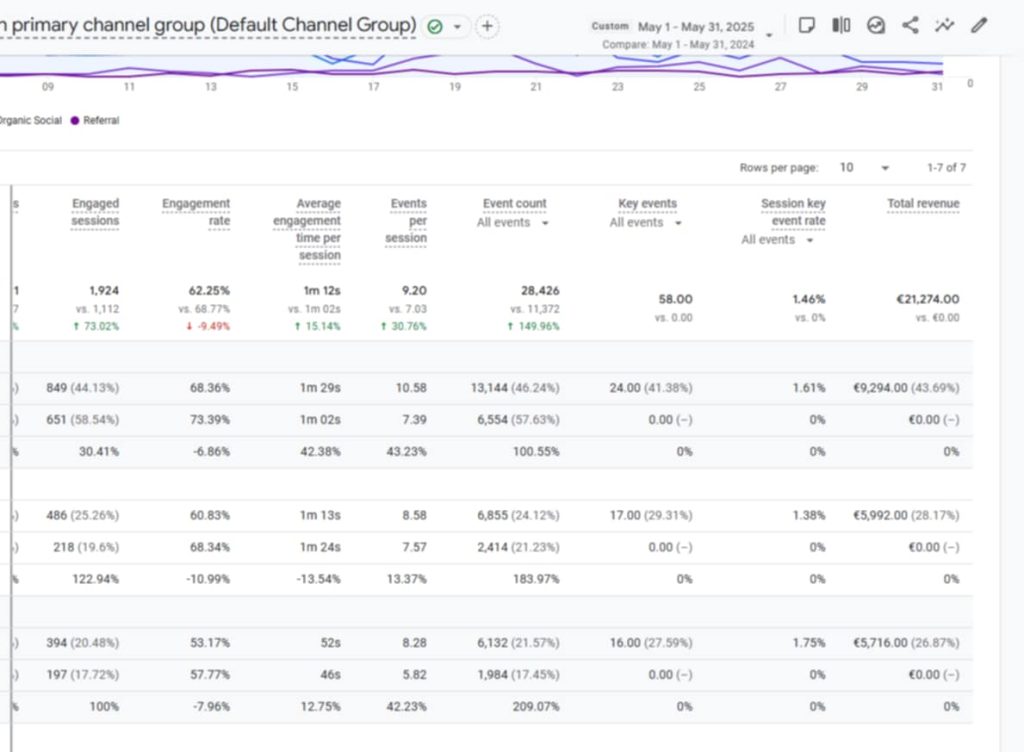
Two of our clients show you how a targeted approach to SEO and CRO can turn a passive website into a powerful business tool.
Client Example 1
• Organic search visits in 2024: 622
• Revenue from purchases in 2024: € 0
• Organic search visits in 2025: 1,116
Revenue from purchases in 2025: € 8,308
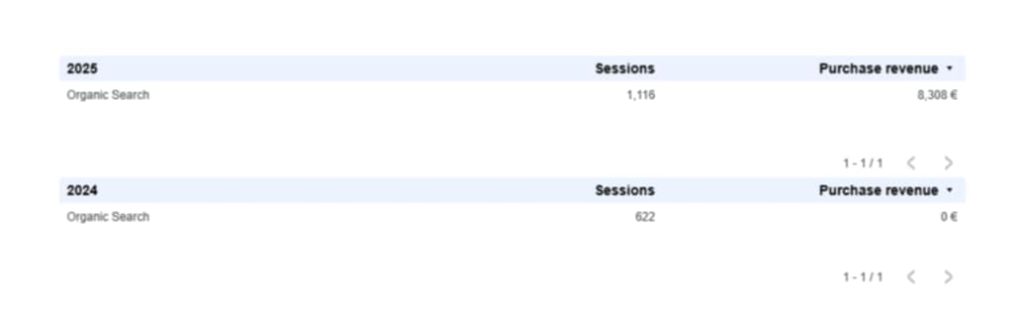
Here we see a 507.1% increase in visits and a shift from zero revenue to a measurable return on investment, thanks to SEO optimisation, targeted content and an upgraded user experience.
Client Example 2:
• Organic search visits in 2024: 84
• Revenue from purchases in 2024: € 0
• Organic search visits in 2025: 510
• 2025 Purchase Revenue: € 8.907
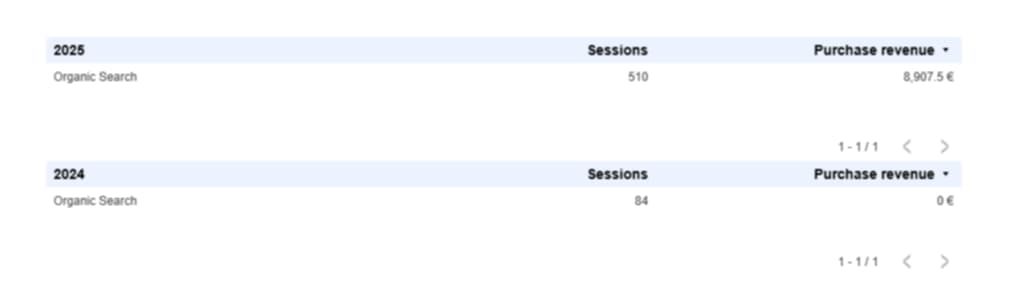
In this case, strategic improvements to content structure and usability led to a 79.4% increase in traffic and a significant rise in revenue from previously untapped organic channels.
These are not isolated results; they are examples of what is achievable when your website is treated as a business tool rather than a simple shop window.
Final Thoughts
If your website does not attract, convert and retain customers, it is not fulfilling its purpose. In an economy driven by online presence, why your company website is much more than a simple “online presence” is a matter of survival, not just performance.
Refreshing your website is not an aesthetic choice; it is a strategic investment. The companies that will grow in 2025 are those that see their website not as a digital brochure, but as an integral part of their marketing and sales system.
Resources:
Search Engine Optimization (SEO) Starter Guide
Expand your SEO and marketing knowledge
See also, Why is my page not shown on Google?